What is an ATC game?
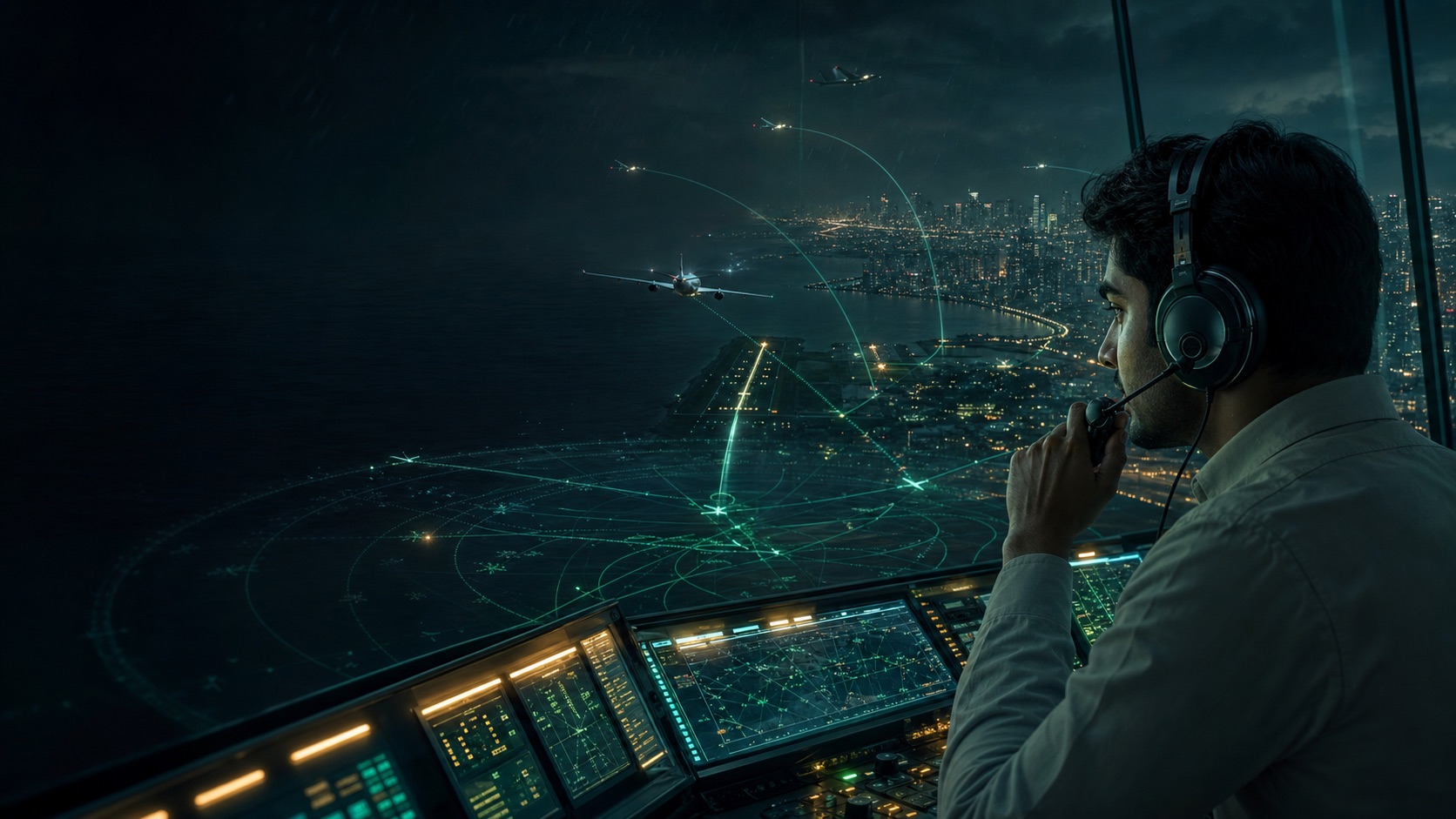
An air traffic control game puts you in charge of the airspace rather than flying an aircraft. You read a radar display, talk to pilots, and decide where every aircraft goes. In Talk to Tower you issue headings, altitudes, speeds, approach clearances, and handoffs while keeping aircraft separated from each other.
What does an approach controller actually do?
An approach controller owns a volume of airspace roughly 30 to 40 miles around one airport. Arriving aircraft enter that airspace high, fast, and not aligned with the runway. The controller turns, descends, and slows each one until it can intercept the runway ILS beam, arranges the arrivals into one evenly spaced stream, then transfers each aircraft to the Tower controller who issues the landing clearance.
How does the ILS work?
The Instrument Landing System transmits two radio beams from the runway. The localizer indicates whether an aircraft is left or right of the runway centreline. The glideslope, normally angled at 3 degrees, indicates whether the aircraft is above or below the correct descent path. When an aircraft captures both beams, its autopilot follows them down to the runway.
Why do aircraft need vectors to the ILS?
The ILS beams are usable only from a narrow window: approximately 10 to 14 nautical miles from the runway, within about 30 degrees of the runway heading, and below the glideslope. An aircraft arriving too high or crossing the centreline at a steep angle passes through the beam without capturing it. Positioning aircraft inside that window is the controller core task.
What am I looking at when the game starts?
A radar scope with the airport at the centre. Each moving symbol is a simulated airliner labelled with its callsign, altitude, and speed. A dashed line extending west of the airport is the ILS approach path for runway 27. You select an aircraft, then talk to it.
Do I need aviation knowledge to start?
No. The guided training shift assumes you know nothing and explains each concept at the moment you first need it. The aviation logic is realistic, but the pacing and feedback are designed for a first-time player.
Can I play this air traffic control game with my voice?
Yes. Talk to Tower is built around push-to-talk voice clearances and spoken pilot readbacks. Keyboard input is always available, so the complete game works if you would rather not speak or cannot grant microphone permission.
Is this a realistic ATC simulator?
It is realistic about the part it simulates and honest about what it leaves out. Approach control at Mumbai is modelled from published charts: real callsigns, absolute headings, separation minima, and localizer and glideslope capture computed from the aircraft actual position rather than scripted. It does not simulate ground movement, taxiways, multiple runways or live weather, and Tower is still in development. If you want a full airport operation, a desktop simulator like Tower!3D covers more; if you want to control traffic by speaking, this is the only one that works that way.
Is Talk to Tower realistic?
It uses recognizable approach-control procedure: real callsigns, absolute headings, altitude and speed assignments, separation minima, localizer and glideslope capture, and Tower handoffs. Mumbai runway geometry and the ILS procedure are projected from published charts. It is a game and a training aid, not certified software, and is not for operational use.
Is the game free, and do I need an account?
The web beta is free to start and guest play requires no account. You can optionally create a controller account to keep career progress across supported devices.
Can I play on mobile?
The web game runs in modern desktop and mobile browsers, and the desktop version is a wide information-dense console. A dedicated Android build exists, with iOS planned; both use the same voice-first control concept.
How do I report a bug or request a feature?
Open an issue on the GitHub repository at github.com/aliacollins/talk-to-tower/issues. Bug reports, phraseology corrections from controllers, and airport requests are all welcome.